Tuesday, 17 November 2015

Action Thriller Genre Conventions

Action Thriller Genre Conventions

Our group decided that we wanted to do an action thriller opening, as it is a genre we are all familiar with, and one that has many conventions. We looked at some action thriller openings see what these conventions are. We looked at the openings for Bourne Identity, Casino Royale, and Memento, and found that there are many similarities between the openings.

     Sound

We found that the music in the openings was often instrumental, using mainly string instruments. This is used in scenes where tension is wanted. When there is action (eg. end of Casino Royale clip) or things are getting dramatic (eg. end of Bourne Identity clip) the music becomes faster, and more instruments are added. Diegetic sounds are heard as well, although the music normally comes first. This can be speech (Casino Royale and Bourne Identity) as well as weather, or objects hitting each other.

     Shot Types & Camera Movements

The shot types used most often in the openings were long shots, close-ups and extreme close-ups. The long shots help establish the setting (Casino Royale) and/or atmosphere (Bourne Identity). The close-ups show emotions, and the extreme close-ups, which often focus on objects, show the importance of the objects (Memento). The movement in the openings are quite basic - they generally all only use camera movements to follow a person or object. Bourne Identity and Memento both use shaky movements, whereas Casino Royale is much smoother until the fight scene at the end.

     Editing

The editing was relatively slow. In Memento, the first minute or so is one continuous shot, with the editing remaining fairly slow throughout the opening. The other two both also have fairly slow editing, even in Casino Royale during the fight scene. This slow edit pace creates tension in the viewer, even in the fight scene where the pace makes the viewer feel more nervous.

     Locations

In terms of locations, they differ greatly. The Bourne Identity opening is set in the ocean, on board a fishing ship and out in the water itself. Casino Royale is set in an office in Prague, and in some toilets. Memento is set in some abandoned and neglected building. Overall, there is no linking theme, apart from the idea that they are all quite isolated areas.

     Colour Schemes & Titles

The colour schemes in the clip were generally quite dark. The colours were occasionally stylized, for example the Casino Royale opening was entirely in black and white, with it becoming quite bright later on. In Memento as well, black and white is used for when the time skips back into the past. In Bourne Identity and Memento, the colours are quite dim and muted. Other than this, again, the colours vary greatly. Bourne Identity uses blue and yellow colours, Memento uses dark colours, and Casino Royale uses greys.

     Content

There are themes of violence and death in all three of these openings. Guns also feature in both Memento and Casino Royale. The main character is also seen in all of these, even if only in the distance (Bourne Identity). Bourne Identity and Casino Royale both take place in a foreign country or place, and none of the openings seem to take place in character's homes.

Thursday, 12 November 2015

Movie Genres

Movie Genres

I decided to look into movie genres to help me decide what genre to make my opening in. This is what I found out:

ACTION - films filled with action, often including chases, stunts, fights, and destruction. They are quite fast, and generally have simple, easy to understand plots, designed to allow the viewer to escape reality.

COMEDY - films made to make people laugh. They once again have simple plots, with often exaggerated characters or situations. There are lots of different types of comedies, including slapstick (physical comedy), parodies (which make fun of something else) and dark (satirical comedy).

ANIMATIONS - films that are animated. They can be hand-drawn, CGI, or claymation, amongst others. The stories vary greatly, and animation is sometimes incorporated with live action. However, animations are more commonly used for children or family films.

ROMANCE - films based around love, and two characters falling in love. They are generally quite light and easy to watch. A sub-genre branching from this is rom-coms, which are about characters falling in love, but with comedic elements and problems.

WESTERN - films set in the desert, or in the wild west. They are based around cowboys, and often include bad guys, shoot-outs, fights and adventures.

HORROR - films made to scare people. There are different types, but they generally involve a group of people being attacked by a monster/supernatural being/psychologically unstable human. They also often include violence, gore, and jump-scares.

THRILLER - films designed to keep audiences at the edge of their seat. They often include plot twists and tense situations. Thrillers are generally attached to another genre, for example action-thrillers. This means that the films involve themes from one genre, but are more tense and have more complex plot-lines.

SCIENCE FICTION - films that include futuristic or alien technology, places, or beings. They often cross over with other genres, including action, horror, and fantasy. They are quite imaginative, and their plots can range from simple to complex.

FANTASY - films that are full of imaginary places, beings, creatures, technology, and worlds. They are very creative, and the plots range greatly. However, they commonly include quests and evil vs good.

CRIME - films that involve gangsters or criminals of some kind. They often show the activities or lives of these people. There are different kinds, including stylish ones, comedy capers, or gritty ones.

FAMILY - films that are designed to be enjoyed by all members of the family, from young children to old people. They generally have simple plots and light-hearted stories, where a happy resolution is always reached.

HISTORICAL - films based in the past. They generally focus on a character, either factual or fictional, and their life, which can be ordinary or extraordinary. They are also sometimes based around past significant events, such as a war or a rebellion.

MUSICALS - films that incorporate song and dance as part of the story. The stories are often quite emotional, and generally end quite well. The plots are quite simple, and often end with 2 characters falling in love.

Thursday, 5 November 2015

Extra Work

Extra Work

I have recently been attending the BFI film academy at film oxford, and have been keeping a blog on what we are doing as part of my silver arts award. As well as making our own short films, we have also had talks from professionals in the industry, including a screenwriting session and VFX talk. Below is the blog that I am keeping. The course has given me lots of extra knowledge and experience which will help me with this course. Posts with a 'B.' are about the sessions and activities I have done.

Sunday, 25 October 2015

Opening Credits Analysis

Opening Credits Analysis

     Superman (1978)

GENRE - Superhero/Action

SOUND - There is an non-diegetic orchestral soundtrack playing throughout. We hear drums, strings, and horns, to name a few instruments. The music is quite upbeat and exciting, creating an epic mood, and the idea of something incredible taking place. It seems to sweep the viewer off their feet and insert them into a thrilling story. The sound is quite loud and immersing right from the beginning, showing that it will be an exciting caper throughout. The only other sound heard is the whooshing of the names as they fly towards or away from the viewer.

VISUALS - The opening starts with a black and white theatre film of a boy reading a comic, which sets up the movie and shows that the film is based off a comic book. During the names, the main background is a film of space, showing stars and galaxies. This  tells the viewer that there will be themes of sci-fi, in that Superman is alien. There are also images of fire and sparklers, creating a mood of excitement and danger. These images create an epic and excited feeling in the viewer, and makes the film seem out of this world and extraordinary. The text flies in front of this, creating the idea of flight, which reflects Superman in the film.

FONT - The font is an outlined electric blue colour. It is quite big and blocky, without serif, which make it seem cosmic & out of this world, and like it's come from space. The glowing outline makes it seem as if it is made of light, adding to the idea of the film being big and epic. The mood created is one of something awesome, an amazing story that is like nothing ever told before.

GENRE CREATED - From the opening, the movie seems like it's an epic and incredible story, that will leave it's viewers gasping for breath in their seats. However, it does suggest that it is set in space, and that it is an action sci-fi film, which it isn't really.


     Skyfall (2012)

GENRE - Action/Spy

SOUND - The only sound we hear is a non-diegetic soundtrack. It starts simple and quiet - a single piano, and then a woman's voice. Her voice is haunting and mysterious, creating a feeling of mystery in the viewer. The sounds then builds up, as more instruments are added. The overall sound is quite dramatic and mysterious, creating this mood in the viewer. The music also has the traditional James Bond theme incorporated, telling the viewer that it is a Bond film, so they should expect the normal themes of mystery, action and romance, amongst others.

VISUALS - The footage is not from the film, but relates to it. The main colours are dark blue, which is mysterious, and red, which suggests violence. Orange fire is introduced later, and then a stylish black and white sequence. These suggest the atmosphere of the film - mystery, violence and death, plus a certain stylishness and class. The sequence is also rich in symbolism. There are lots of things that symbolise death, including graves, skulls, bulletholes, guns and knives. There is also a lot of blood and shadows. There is also lots of symbolism for physical things, such as the house they visit and the chinese dragons that suggest they are going to China.

FONT - The font is very simple, yet also very stylish and clean. It is white, rounded, and without serifs, which creates an impression of style and class. The font also looks very professional and smart, reflecting the atmosphere of Bond films.

GENRE CREATED - The opening credits create a mood of mystery and of style, but also of action and fighting. This successfully captures the genre and themes of this Bond film.


     Coraline (2009)

GENRE - Animation/Fantasy

SOUND - The sound is non-diegetic and starts quite quiet, never becoming particularly loud, although building up past the quiet beginning. The sound is a non-diegetic soundtrack, and sounds quite creepy. At the beginning, the sound fades in from complete silence, and we can hear strings and high piano solo. The sound of a chorus of indecipherable children's voices is heard, creating a creepy atmosphere. These sounds are the main ones used throughout, along with an indecipherable lower male voice. This is quite creepy, and puts the viewer on edge, but later on the sound becomes more wondering and magical, hinting that it won't be entirely dark, and there will also be a mood of intrigue and wonder.

VISUALS - At first, the background looks like it's made of leather, with the text sewn on top of it. This establishes the theme of sewing and textiles used throughout the film with the dolls. This is used to introduce the production companies and main actors. After this, we then see an animated film that acts as an establishing prologue, showing robotic, spindly pincers disassembling then reassembling a cloth ragdoll. The actions are quite vicious and violent, which puts the viewer on edge and creates an atmosphere of unease. This introduces us to the character of the mother, and to Coraline through the doll. The colour is quite dark, grey, and desaturated, hinting at the creepy, dark atmosphere to the film.

FONT - The font is an old-looking classic font, with swirls underneath that make it seem slightly gothic. It is slightly faded, creating a creepy and uneasy atmosphere. This creates an idea that the film will be quite dark and slightly mysterious, and almost gothic in nature. The font is a grey-white, adding to the dark and mysterious mood.

GENRE CREATED - Overall, the genre created is one of dark yet intriguing mystery, with gothic tints. It also seems quite creepy and scary.


     Aladdin (1992)

GENRE - Animation/Adventure

SOUND - The opening is a song, which at first seems like a soundtrack, but at the end seems to have been sung by a turbaned arab man. The music is quite basic at the beginning, with only a few instruments and the singing, but builds up midway through. It starts with an arabic-sounding pipe and some drums, introducing the film as taking place in Arabia. The arabic sound continues throughout the opening credits song. The beginning creates an atmosphere of mystery, which changes to an atmosphere of excitement and adventure once the sound builds up. We also hear other diegetic sounds, like the thud of the camels footsteps.

VISUALS - The first thing we see is a picture of fire and purple smoke. This creates a feeling of mystery and wonder. Images are then shown of the fiery, desolate desert, showing the setting, and how removed and empty the desert is. The majestic palace is then shown, creating a mood of wonder and amazement that the viewer associates with the palace for the rest of the movie. The image then swoops through the streets, showing crowds of people and a street entertainer. This creates a mood of excitement and adventure, and shows what an exciting, busy place the city is. Overall, the viewer gets an atmosphere of wonder, magic and excitement.

FONT - The font is a gold colour, which hints at treasure and also creates an idea of wealth. It also matches the arabic font used, which helps establish the setting of the film. It helps to show the exoticness and mystery of the film.

GENRE CREATED - Overall, an atmosphere is created of mystery, excitement, adventure, and a touch of magic. It also establishes the arabic setting of the film.


     A Shot in the Dark (1964)

GENRE - Comedy/Detective

SOUND - Both diegetic and non-diegetic sounds are used in the opening credits. A soundtrack is used, which sounds quite jazzy. It creates the idea of someone creeping along, showing the mystery, but it also sounds comical, showing the light and comedic side of the film. There are 2 breaks from the soundtrack at various parts; the can-can when some detached legs dance along the screen; and a romantic violin tune during the sound credits. This suggests themes of sex and romance in the film. Diegetic sounds are also used. The main sounds are comical gunshot sounds, which show the action and danger, but also the comedy of the film. There is also an exaggerated shriek and a whistle-blow, but no speech.

VISUALS - The opening credits play over a cartoon of a comedic-looking detective with a massive chin wandering around and getting blown up. This shows that it is a detective film, but also creates an atmosphere of humour and slapstick. The colours are vivid and quite blocky, showing that the film will not be very serious, an will be quite bright and funny. There is very little symbolism in the opening credits, only visual gags and slapstick.

FONT - The font for the main title and any important names, such as the actors of the main characters, is very mixed. The letters all seem to be different styles, including western, newspaper, simple, and pretty, plus a target board. This creates an impression of the film  and the main character being slightly messy and funny. It also seems comedic, showing the comedy of the film. Less important names and titles use a much more simple font, creating an impression of smartness and cleanness.

GENRE CREATED - The opening clearly establishes that the film is a comedic detective parody, which can be seen in the comedic slapstick and hints at detective mystery films.

Friday, 16 October 2015

Preliminary Task: Analysis and Self Reflection

Preliminary Task: Analysis and Self Reflection


     Shot/Reverse-Shot


I would give myself 6/10 for my use of shot/reverse-shot because although we used it successfully so that the audience saw what me and Samuel saw, it would have been better if we had used an over the shoulder shot instead.
We used shot/reverse-shot during the scene when me and Samuel were talking. We started by filming a high angle shot of me looking up at Samuel. As he was standing and I was sitting, he would be looking down on me. This made the audience feel as if they were Samuel, creating a closer connection between the audience and Samuel. This connection made the audience more invested in the scene, and therefore more invested in the story. This was the same when we filmed Samuel from my perspective, using a low angle shot to show what I saw. The use of shot/reverse-shot made the viewer see the story from our perspective, making them more invested and interested in the film.

     Match on Action


I would give myself 8/10 for match on action. I tried to edit my film to make it as smooth and continuous as possible, so that no actions were skipped or repeated. There are a few instances, for example when Samuel walks towards the table, that aren't perfect, and feel as if something is wrong.
I mostly worked on perfecting the match on action during editing. When filming, we mostly filmed the same scene repeatedly but from different angles. This meant that the match on action in the uncut edits was imperfect and lacked continuity. When I edited, I tried to make the edit smooth and continuous by ensuring actions were not skipped or repeated. By doing this, the film felt more grounded in the real world. The match on action made the film seem as if it was taking place in reality, which made it more believable. This engaged the viewer more, making them more interested in the film. Also, if match on action had been obviously imperfect, it would have distracted the viewer, made them less engaged, and taken away from the story.

     180 Degree Rule

Set up of cameras following 180 degree rule
I would give myself 10/10 for 180 degree rule because we did not break it at any time during the film.
To ensure we kept the 180 degree rule, we kept the camera on one side of the room at all times. Even when we were filming outside the room, when Samuel enters, we made sure to stick to the same side. This means that we see Samuel opening the door furthest from the camera in one shot, then walking through the furthest door in the next shot. By sticking to the 180 degree rule, we made sure that continuity was correct. If we had broken the 180 degree rule, we would have broken the continuity, as Samuel would have walked one way, then the other. By using the rule, the film was smooth and the viewer was not distracted from the story. This meant that the viewer could follow the story and stay invested in the film without any distractions or confusions.

     Tilt


I would give myself 7/10 for our use of tilt, as it was used well, but could have been smoother and cleaner.
After the camera had panned to follow the ID card passing along the table, it tilted up, following the ID card and revealing my face. The effect of this was that it showed the importance of the card, and the fact that it was the focus of our meeting. This made the viewer intrigued as to why the card is so important, and what is going on in the scene. This made our film more engaging and interesting, as the audience becomes more invested in the story.

     Pan


I would give myself 6/10 for our use of panning shot. This is because although it was used well, at some points it wasn't particularly smooth, and seemed a bit shaky.
We used a pan twice in our film; firstly when Samuel was crossing the room, secondly when the ID card was slid across the table. I think our first use of it was slightly less successful, as it was slightly wobbly, and made the film feel less perfect. However, we used it to good effect. By following Samuel's walk, we showed his journey across the room while also keeping a feeling of mystery about who he is, as we hadn't revealed his face yet. By using a pan, we also created a feeling of movement. This helped the viewer feel as if they were moving with Samuel, making them feel more involved and therefore more engaged. With the second pan, the one used to follow the ID card, it showed the importance of the card, as the viewer followed it. This made the viewer intrigued about why the ID card was so important, and what it meant for the story. This, again, made the viewer more engaged in the film.

     What I Have Learnt About Filming
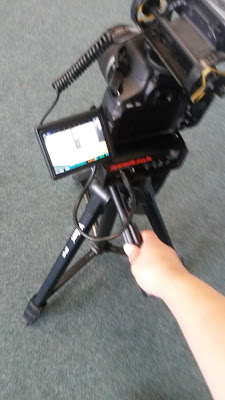
Filming this preliminary task has taught me several valuable lessons about filming. Firstly, I have learnt that it is very difficult to film with two people who are both filming and acting. Next time I will definitely film with one extra person than the number of cast in any given scene. Besides this, however, I have also learnt the importance of following the rules of filming, especially match on action and 180 degree rule, as using these correctly means that the viewer is always involved, and they forget that they are watching a film and begin to believe that the film is real. I will take extra care to make sure that these rules are followed, so that the film is absorbing and engaging. I will also make sure that if we use pans and tilts that they are smooth, as when they go wrong (like when Samuel is walking) the audience is distracted from the story of the film. I would also use over the shoulder shots, because there is something slightly odd about just filming a person on their own talking with another person, possibly because it makes them seem as if they are not talking to anyone. Next time I film something, I will definitely follow these rules.

     What I have Learnt About Editing

I have learnt many things about editing when making the film, mostly because I have never edited something by myself before, and I have never used Final Cut. One thing I have learnt about editing is that most of the sounds, effects and titles in Final Cut are incredibly cheesy. It is very easy to make something silly, cheesy, and funny using Final Cut - editing something serious is far more difficult. However, finding good, simple titles is relatively simple, and basic effects can be found as well. The real problem is avoiding the temptation to make a rainbow coloured flashy film with star wipes and bouncy music. I think next time I edit I will use a royalty free music website to find any backing tracks and sounds, as Final Cut's are fairly rubbish. I think one successful aspect of my editing is the length of the shot cuts, as all of them are a fairly good length. I did this by doing what felt natural, which probably comes from the ideas I've absorbed from years of watching films. This means for my actual film I will do whatever feels right and natural in editing.

     Shot Types

I think the most effective shot in our film was the two shot, with a medium close up of Samuel and a long shot of me. I think it is effective because it allows the viewer what I am doing (standing up) and how Samuel reacts.

Our most effective shot
One shot I wish we had gotten was a medium close up when Samuel says 'You'll understand one day'. The shot we have for that part is a mid shot, but from very far away. This looks very strange, and would have looked better if it was closer. The distance between the viewer and Samuel distances them, making the connection between viewer and story lessen. A closer shot would have kept the connection and have shown Samuel's face as he reacted. I would also have filmed more close up reaction shots, just so the audience could understand what me and Samuel were thinking.


The shot I would have changed

Friday, 9 October 2015

Production Notes

Production Notes

A lot of work went into our preliminary task. Before we made the film, we had to storyboard it, shoot it, and then edit it. It was a long process, but necessary in making our preliminary film.


     Storyboarding

We started our preliminary task by storyboarding. Me, Samuel and Daniel, once we had a concept, worked together to create a storyboard. None of us were particularly good at drawing, but we still managed to outline our ideas into a storyboard. We also put short notes next to the pictures with any necessary extra information. I think that the process of storyboarding was useful, as it made us think about how we could shoot it and discuss what would and wouldn't work. However, our lack of artistic skills did make the process slightly difficult.


Parts of our storyboard:


     Filming

Me and Samuel filmed our piece on the 29th September in one of the classrooms in school. It took us about an hour to film, with me and Samuel both behind and in front of camera. 


Filming our preliminary task:


It was quite difficult having only two of us filming the task, but using a tripod we managed to do it. We would test out the shot by having one of us on screen and the other checking that the shot looked good, then if necessary swapping around to check for the other person. For shots which required camera movements, we would set it up so that only one of us would have to be in frame, with the other person working the camera. For example, in the shot where the camera pans to follow Samuel's feet walking, he walked and I rotated the camera. Generally, however, we set up the tripod, pressed record then ran into position to film.


The storyboard compared to frames from the actual film:


When filming, we mostly stuck to the storyboard we had drawn up the week before. This was useful, as it meant we didn't have to think about what shots to do, and we knew what we had to film and what the shots should look like. Once we had got all the shots on our storyboard, we filmed from other angles as well. This was when we filmed my favourite shots, the one when I tell Samuel 'wait'. We were lucky to have a few minutes to spare at the end, as if we hadn't we would never have got that shot. This alerted me to one drawback of storyboarding, which is that it can be slightly restricting; if we had not have had any extra time, that shot would have never been taken.


My personal favourite shot:


Overall, our filming was quite successful. We managed to film everything we needed, and our shots looked good. However, having only the two of us was very difficult, and if I were to do this again I would definitely use three people to film it.


     Editing

My preliminary task was the first thing I had ever edited on my own, so I am very pleased with how it turned out. The first thing I did when editing was to decide what genre it would be, as this would have an impact on the colour, speed, sound and titles. I decided that my film was in the mystery genre, so I edited it to match that. For colour, I went with a fairly low saturation and exposure. This made the film feel moody and dark, which added to the mystery of the film. The speed was fairly average, maybe slightly slower, and matched with the natural sound to make the film feel realistic. The only sound I added was in the title and end sequences, where I chose noises that matched my genre - a typewriter for the title and a low, moody music piece for the end screen. The title sequences were basic, and I added in no effects which added to the realistic tone of the film. Overall, I think the editing was successful. The continuity was pretty much perfect, and the film suited the mystery genre well.

     Overall

Overall I think my preliminary task was quite successful. The planning, filming and editing all went well, and the overall film, for a first attempt, is quite good. The thing I am the most pleased with is the shot I mentioned above and the fact that two of us managed to both film and feature in the film. However, if I was to do it again, I would make sure that there were three of us filming and use a different angle for the part when Samuel says 'you'll understand one day', as it seems quite distant and far away. I also would have recorded some footage that was just the background noise, as during the editing I had to remove the noise from a few of my shots for the sake of continuity, and if I had recorded some background noise then I could have used that instead of silence, which doesn't fit well. Despite these things I think the task was a success overall.